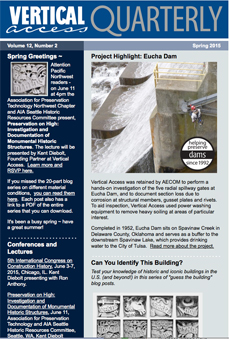
Check out our Spring 2015 Quarterly newsletter.
Learn how available technological tools help to improve the collection and management of graphical and numerical information derived from building surveys.
DATE: June 11, 2015
TIME: 4:00pm – 6:00pm
LOCATION: Commons, 107 West Denny Way, Suite 303, Seattle, WA 98119
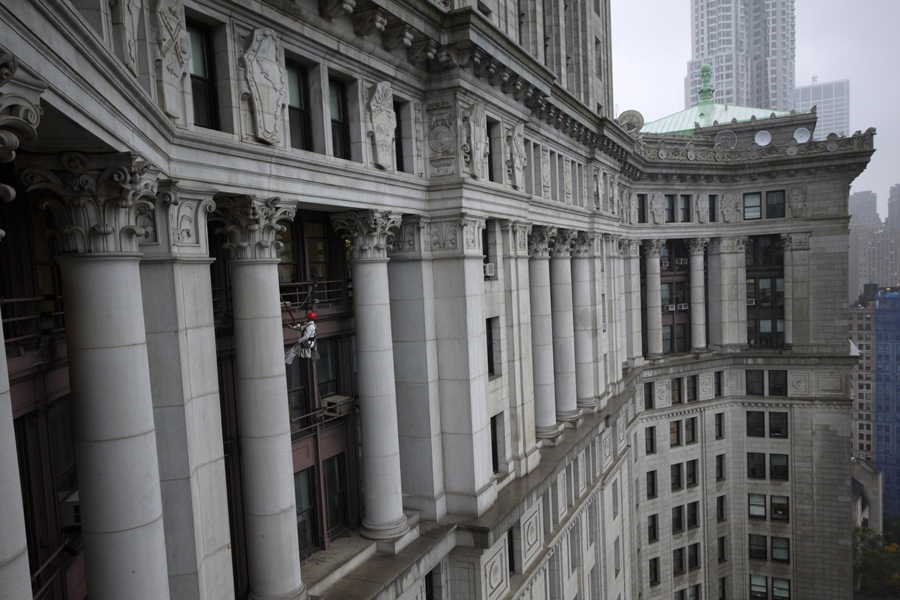
Preservation architects, engineers and others involved in the renovation of historic buildings agree on the importance of an efficient and thorough discovery phase. A significant part of that effort is the organized collection of building information and accurate documentation of existing conditions. Even though these discovery tasks are such a significant part of a project, the development and incorporation of tools to improve the process on site and process the resulting information has been slow to develop.
This presentation examines some components of a successful early discovery phase on monumental historic buildings and reviews some technological tools that help to improve the collection and management of graphical and numerical information derived from building surveys.
Presenter
 Kent Diebolt is the founder of Vertical Access and has been the principal-in-charge for most investigation, testing and inspection projects performed by Vertical Access over the firm’s 22-year history. Since the first Vertical Access project in 1992, Kent and his team have inspected numerous historically significant buildings, constructed of a wide variety of materials. He is an active participant and is a leader in professional preservation and rope access organizations.
Presented by Association for Preservation Technology NW and AIA Seattle Historic Resources Committee

Each post in this series provides an in-depth look at one of the standard conditions we encounter and document during inspections of buildings and civil structures. The full series is indexed here and is also available as a pdf download. Thanks for following along!
Part 1: Cracks and Crack Systems in Masonry
Part 2: Crazing
Part 3: Spalls
Part 4: Efflorescence and Leached Salts
Part 5: Surface Loss
Part 6: Failed Joints in Masonry
Part 7: Atmospheric Soiling and Black Crusts
Part 8: Biological Growth
Part 9: Guano
Part 10: Pack Rust
Part 11: Displacement
Part 12: Hollow Areas
Part 13: Failed Coatings
Part 14: Previous Repairs
Part 15: Glass Conditions
Part 16: Plaster Conditions
Part 17: Metal Conditions
Part 18: Wood Conditions
Part 19: Slate Conditions
Part 20: Stucco Conditions
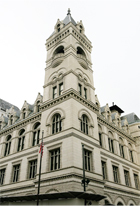
On April 30, 2015 the New York Landmarks Conservancy presented their annual prestigious Lucy G. Moses Preservation Awards for outstanding preservation projects in New York City.
Vertical Access is proud to have been part of the team that received recognition for the restoration of the Conrad B. Duberstein U. S. Courthouse in Brooklyn, NY.
Project Team
General Services Administration
Goody Clancy & Associates
Boston Valley Terra Cotta
Jablonski Building Conservation
Nicholson & Galloway
Preservation Design
Robert Silman Associates
SUPERSTRUCTURES
Vertical Access
Vidaris
Learn more
The New York Landmarks Conservancy
General Services Administration
Traditional Buildings Magazine
Test your knowledge of historic and iconic buildings in the U.S. (and beyond!) in this series of “guess the building” blog posts.
Series No. 4:
These sculpted limestone panels were spotted during a tower investigation of an early twentieth-century church. You’ll need binoculars to see them in person, since they’re about 80 feet above the sidewalk.


Don’t miss another architectural challenge: subscribe to our blog by signing up with your email address in the sidebar. Click here to see all of the posts in this series.
Photos by Vertical Access.
by Kevin Dalton
I recently attended the opening reception for Feats of Clay: Philadelphia Brick and Terra Cotta, an exhibition on the legacy of Philadelphia’s brick and terra cotta industry at the Harvey and Irwin Kroiz Gallery, The Architectural Archives of the University of Pennsylvania, curated by Frank Matero.
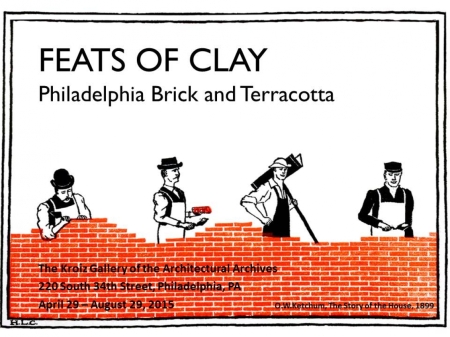 The exhibit included artifacts from now demolished buildings designed by Philadelphia architects Frank Furness and Cope and Stewardson, brick from works by Louis Kahn as well as examples of some of the cities most underappreciated residential works such as Edgar V. Seeler’s Conkling and Armstrong House in the city’s Nicetown-Tioga neighborhood and the Morris Fleisher Residence designed by Willis G. Hale and located in the Fairmount section of the city.
Featured alongside the architectural works were interesting catalogs, brick samples and maps of past and present Philadelphia area brick and terra cotta manufactories such O.W. Ketchum, Sayre & Fisher Brick Company, McAvoy Brick (which still operates in Phoenixville, PA) and some wonderful examples of the ornamental clay products produced by Peerless Brick Company.
Having trained as a bricklayer since the age of 18, I spent several years working out of the Bricklayers and Allied Craftworkers Union (Local 1 PA/DE) in Philadelphia and have grown to love the wonderful brickwork that is ubiquitous in Philadelphia. This exhibit focuses on the city’s long and storied history of brick manufacturing and the architectural masterpieces that resulted and also serves as a stark reminder of the treasures that we have lost.
For those of you who are brick enthusiasts like me, you can find some of these amazing brick and terra cotta remnants of the past for purchase at several architectural salvage stores in and around Philadelphia such as: Provenance Old Soul Architectural Salvage, Philadelphia Salvage Company and Harry Bambi Supplies.
Gallery hours are 10:00 AM – 5:00 PM Monday-Friday. The exhibit runs through October 9, 2015.
Each week we’re bringing you an in-depth look at one of the standard conditions we encounter and document during inspections of buildings and civil structures.
Part 20: Stucco Conditions
Stucco is a cementitious coating applied to masonry, wood, or metal lath as a watertight exterior finish. Historically, stucco was sometimes colored and scored to imitate stone.

Cracks through stucco scored to imitate stone masonry
Stucco conditions include cracks; sound and failed coatings; ferrous embedments; failed sealant; prior patch, crack, and replacement repairs; various types of soiling; and areas of unsecured or hollow stucco.

Unsecured stucco separating from the brick substrate
Stucco is particularly susceptible to water damage; historically, stucco was often whitewashed or coated with other protective finishes to prevent water infiltration. Water damage from improper detailing, poor foundation drainage, or other sources can lead to rotten wood lath or corroded metal lath and fasteners, causing stucco to separate from the substrate. Cracking due to settlement is another common stucco condition.

Failed crack and patch repairs in stucco
Click here to see all posts in this series.
Click here for an index of all posts in this series, or download a pdf of the complete series.
Each week we’re bringing you an in-depth look at one of the standard conditions we encounter and document during inspections of buildings and civil structures.
Part 19: Slate Conditions
Slate is a metamorphic rock that is easily split along its layers and dressed, yielding an attractive, durable roof tile. In the U.S. slate is quarried in Pennsylvania, Virginia, New York, Maine and Vermont. Natural color variations in slate – including gray, green, purple, and red – are often combined for architectural effect.

Cracked and missing slate
Slate conditions include failed fasteners; cracks; various types of soiling; and unsecured slate.

Loose slate resulting from a failed fastener
Slate roof tiles are generally very durable, with a well-designed slate roof having a service life of at least 60 years, and often 100 years or longer. Slates with greater amounts of impurities are subject to destructive weathering with wetting and thermal cycles. Weathered slates lose strength, becoming more prone to cracks. Steeply-pitched roofs shed water more efficiently, reducing weathering and resulting in substantially longer service life. Metal fasteners are prone to corrosion and eventual failure, leaving loose or unsecured slates. When only a few roofing slates are deteriorated, a roof that is in otherwise good condition can be easily repaired by a skilled roofer.

Failed fasteners and missing slates
Next in this series: Stucco Conditions
Click here to see all posts in this series.
Click here for an index of all posts in this series, or download a pdf of the complete series.
Each week we’re bringing you an in-depth look at one of the standard conditions we encounter and document during inspections of buildings and civil structures.
Part 18: Wood Conditions
Wood is one of the oldest architectural materials. In historic and modern exterior applications, wood may be used in the form of structural timbers or dimensional lumber, roof and wall cladding or underlayment, carved or turned decoration, as a component in door and window assemblies, and in balustrades and railings.

Structural wood members exhibiting biological growth (algae) and rot
Wood conditions include biological growth, which includes both lower plants (fungi, lichens, algae) and higher (vascular) plants; sound and failed coatings such as paint; cracking and checking; infestation by insects or mammals; abrasion, weathering, and rot; sealant failure; sound and failed patch repairs and dutchman repairs; various types of soiling; and unsecured wood due to failed fasteners.

Checked structural wood member
As a plant-based material, wood is subject to some types of deterioration that do not affect other building components, such as rot and insect damage. Rot, which is a type of fungal attack, requires moisture and often occurs when wood elements aren’t adequately protected from the elements by paint coatings or weatherproofing details. Abrasion is wear on the surface of wood from foot traffic, handling, or contact with moving parts such as hardware. Weathering occurs due to exposure to wind-blown dusts, water and ultraviolet light, resulting in discoloration and/or surface loss. Often, the wood’s softer seasonal growth is lost at a greater rate than the denser seasonal growth, resulting in an uneven surface texture. Cracking occurs when wood yields to external stresses, often as a result of weakening by other forms of deterioration. Checking, on the other hand, is splitting along the wood grain caused by drying, and does not typically affect the strength of the wood.

Weathered wood louvers
Next in this series: Slate Conditions
Click here to see all posts in this series.
Click here for an index of all posts in this series, or download a pdf of the complete series.
Each week we’re bringing you an in-depth look at one of the standard conditions we encounter and document during inspections of buildings and civil structures.
Part 17: Metal Conditions
Metals used in the construction of buildings and civil structures include cast and wrought iron, steel, aluminum, copper, lead, zinc, tin, nickel, and various alloys. We document conditions for architectural metal (structural members, windows, spandrel panels, railings, sculpture and cast ornament, fasteners, etc.) and sheet metal (thin metal typically used as cladding for roofs and cupolas, flashing, and as ornament.)

Dented sheet metal grotesque
Metal conditions include failed coatings; failed fasteners; corroded fasteners; prior repairs; various types of soiling; failed sealant; dented metal; and unsecured metal. We distinguish among three types of corrosion conditions: surface corrosion, pitted corrosion, and perforated corrosion. Some conditions affect only architectural metal: cracks, bent metal, failed flange connections and failed welds; and several conditions affect only sheet metals: failed folded seams, failed soldered seams, puncture damage and tearing.

Unsecured cast iron ornament
Corrosion (and failure of fasteners through corrosion) is the principal mode of failure for architectural and sheet metals, especially iron and its alloys. Corrosion is accelerated when dissimilar metals are placed in contact with each other (galvanic corrosion). Corrosion of sheet metal roofing and cladding is accelerated by contact with atmospheric contaminants. When designed for exterior applications, cast and wrought iron were often protected with paint coatings. Loss of protective coatings (paint, plating, or galvanizing) leads to rapid corrosion of iron-based sheet metals. Some metals, such as copper and aluminum, are resistant to corrosion except by galvanic action. Sheet metals are also susceptible to impact damage, fatigue, and tearing.
See also: Pack Rust and Failed Coatings
Next in this series: Wood Conditions
Click here to see all posts in this series.
Click here for an index of all posts in this series, or download a pdf of the complete series.
