How the Tent of Tomorrow Got its New Coat of Paint

Predicted by its organizers to be the “greatest single event in history,” the 1964-65 New York World’s Fair was indeed a spectacle. One of the most notable structures of the Fair, and one of the few that still stands, is the New York State Pavilion. Looking to create a symbol of progress and to show off the state’s status as host of the Fair, Governor Rockefeller commissioned Philip Johnson, who worked with structural engineer Lev Zetlin, to design the New York State Pavilion. The pavilion was in fact an assemblage of three separate structures: the open-air Tent of Tomorrow, three interconnected Observation Towers, and the circular Theaterama.

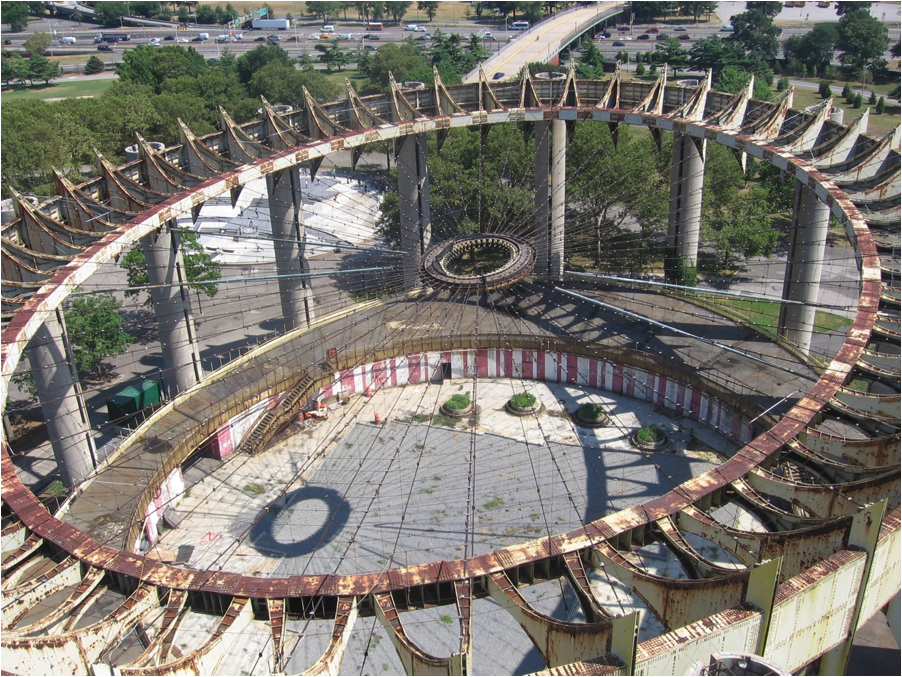
The Tent of Tomorrow was used for several years after the end of the Fair in 1965, first for music and art shows, then as the “Roller Round Skating Rink.” In the summer of 1974, the City closed the tent structure, citing the “hazardous condition” of the Kalwall roof panels. The multicolored roof panels were removed in 1976, leaving the structure in more or less its current state.

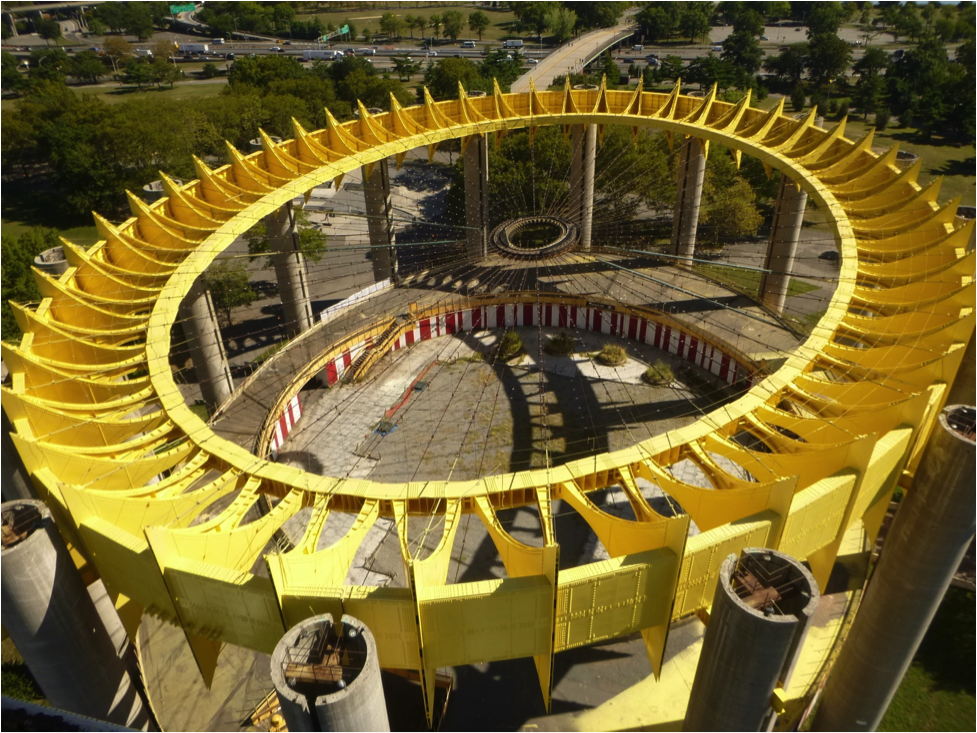
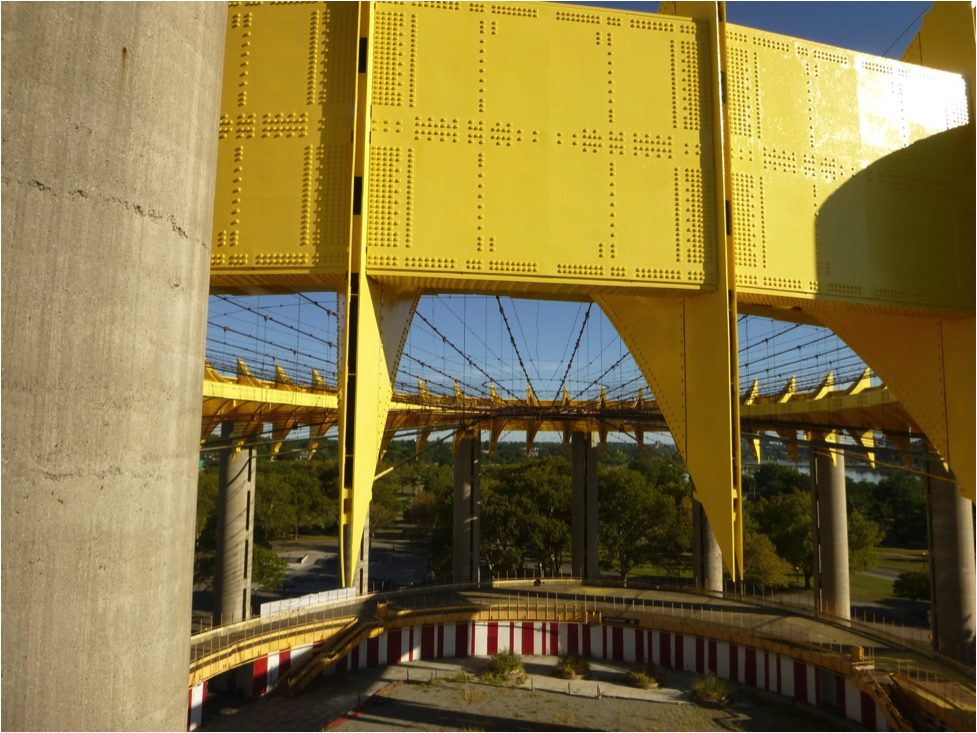
Although unused for over forty years, the Tent of Tomorrow is showing new life thanks to the work of New York area painters. The City of New York Department of Parks and Recreation (DPR) who owns the structure, teamed with the New York Structural Steel Painting Contractors Association and the International Union of Painters and Allied Trades, Local 806 (Structural Steel and Bridge Painters of Greater New York) to complete a spectacular painting project during the summer of 2015.

Labor for the painting project was donated through apprenticeship programs of the trade groups. Funding to provide meals for the crew during the work was raised through crowdsourced funding. The paint job not only returns the steel elements of the Tent of Tomorrow to their original appearance, it also helps to protect the structure from continued corrosion and deterioration. The painting project is one step in the long process being undertaken by DPR and the borough of Queens to stabilize and hopefully one day restore the Tent of Tomorrow and Observation Towers of the New York State Pavilion.

Photos by Vertical Access.

Exploring 3D Photogrammetry

Dozens of software options are available for stitching photographs into scaleable, 2D mosaics or 3D models. We’ve been experimenting with a few different platforms for generating 3D models using footage captured by our DJI Phantom UAV (drone) or by technicians on the ground.

In the example below, the photogrammetry software could not accurately render the metal roof of our shed because the photos used to create the model were taken by a person on the ground. Achieving a higher angle of view, for example, by using a UAV, the software would have created a more complete model. This 3D model was built using only 51 images.

shed point cloud

3D model created using photogrammetry

Some programs can output a 2D elevation or plan extracted from the 3D model, which can be used to create scale drawings with centimeter accuracy.

orthorectified image generated from a 3D model

orthorectified 2D image generated from a 3D model

These outputs can be used as background drawings for a hands-on survey using TPAS, or to take measurements of inaccessible features such as antennas or finials.

This fly-through of a barn is of a 3D model created where the green line represents the flight path of the UAV and the dots represent the locations of where photographs were taken.  Enjoy the drone’s-eye view:

Can you identify this building? – Series No. 6

Test your knowledge of historic and iconic buildings in the U.S. (and beyond!) in this series of “guess the building” blog posts.

Series No. 6:

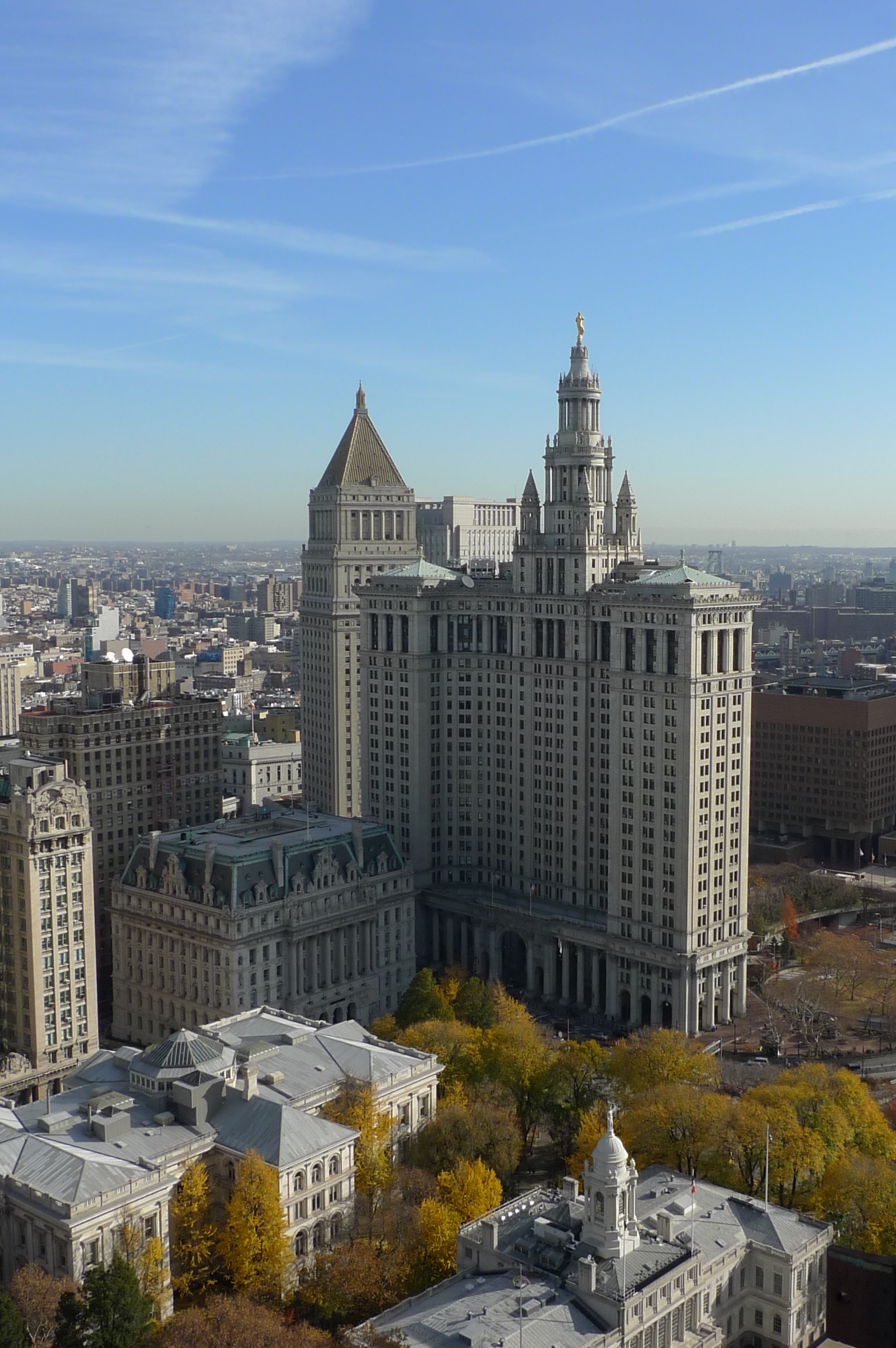
This 25-foot-tall beauty stands atop one of the largest government buildings in the world, a Beaux Arts masterpiece completed in 1914. She holds a five-sectioned mural crown in her left hand, and a shield and laurel branch in her right. Where is this “fame”-ous statue?

P1000149

Screen Shot 2015-05-22 at 12.07.05 PM

Screen Shot 2015-05-22 at 12.09.28 PM

Answer: David N. Dinkins Municipal Building, New York, NY. Built to house an expanded city government following the consolidation of the five boroughs in 1898, it was the first skyscraper produced by the firm of McKim, Mead and White. The gilded copper statue atop its cupola is Civic Fame, by sculptor Adolph Weinman. The building was renamed for former Mayor David N. Dinkins in November 2015 in recognition of his decades of public service including a four-year term as mayor.

P1100420

Don’t miss another architectural challenge: subscribe to our blog by signing up with your email address in the sidebar. Click here to see all of the posts in this series.

Photos by Vertical Access.
Can you identify this building? – Series No. 7

Test your knowledge of historic and iconic buildings in the U.S. (and beyond!) in this series of “guess the building” blog posts.

Series No. 7:

This 25-foot-tall beauty stands atop one of the largest government buildings in the world, a Beaux Arts masterpiece completed in 1914. She holds a five-sectioned mural crown in her left hand, and a shield and laurel branch in her right. Where is this “fame”-ous statue?

P1000149

Screen Shot 2015-05-22 at 12.07.05 PM

Screen Shot 2015-05-22 at 12.09.28 PM

Answer: David N. Dinkins Municipal Building, New York, NY. Built to house an expanded city government following the consolidation of the five boroughs in 1898, it was the first skyscraper produced by the firm of McKim, Mead and White. The gilded copper statue atop its cupola is Civic Fame, by sculptor Adolph Weinman. The building was renamed for former Mayor David N. Dinkins in November 2015 in recognition of his decades of public service including a four-year term as mayor.

P1100420

Don’t miss another architectural challenge: subscribe to our blog by signing up with your email address in the sidebar. Click here to see all of the posts in this series.

Photos by Vertical Access.

APT Annual Conference in Kansas City

Earlier this month, Kent Diebolt, Evan Kopelson and Kristen Olson attended the Association for Preservation Technology International annual conference in Kansas City, Missouri. APT is a cross-disciplinary member organization promoting the best technology for conserving historic structures and their settings. The conference theme was Convergence of People and Places—Diverse Technologies and Practices.

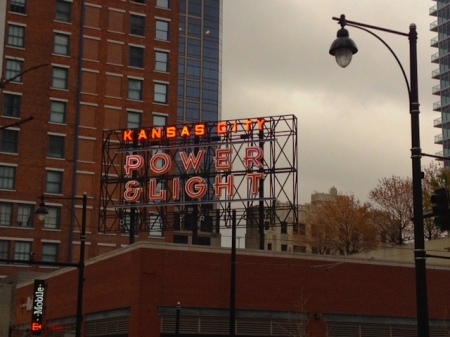
One of many neon signs in the Power & Light District

One of many neon signs in the Power & Light District

The diverse technologies were on display in presentations on 3D laser scanning to aid in flood management at religious sites in Southeast Asia; 3D GIS applications to help plan new uses for Flushing Meadows-Corona Park, site of the 1939 and 1964 World’s Fairs; and a creative fusion of high-tech and low-tech to investigate interior plaster conditions in a historic Charleston residence (infrared thermography aided by a hair dryer).

IMG_3796

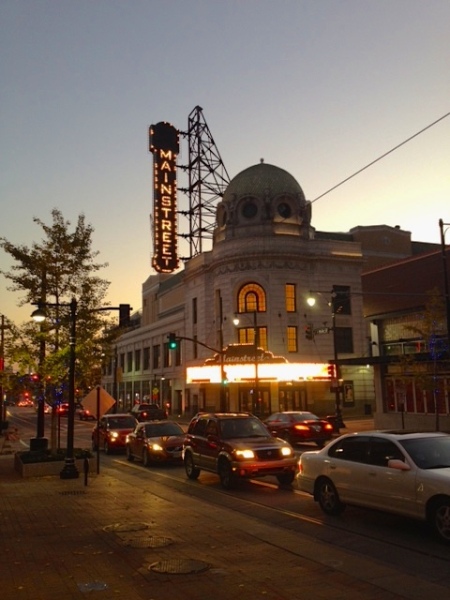
The historic Mainstreet Theater, reborn as a modern cinema

An exciting possibility for documenting post-disaster sites is the use of mobile apps that allow volunteers to quickly and accurately gather data using customized web forms. Meanwhile, web-based databases such as APT’s OSCAR and the National Building Stone Database are putting valuable data on sustainable practices and restoration materials at the fingertips of practitioners.

IMG_3798

A neon sign for the Drum Room lounge at the historic President Hotel

Several presentations tied the social dimension of preservation to larger national and global issues of justice and human health, with a concept of “whole places” that function on all levels. Case studies demonstrated the successful rehabilitation of unloved, Brutalist-style buildings into vibrant spaces for human interaction.

IMG_3801

Spandrel detail on the Power and Light Building, an iconic Art Deco skyscraper

A full-day symposium, Renewing Modernism, addressed the challenges and opportunities presented by buildings of the Modern era. Many presenters called for flexibility and creativity in bringing 20th century buildings up to 21st century energy standards, with a consensus that different standards of both energy efficiency and preservation should apply to buildings relative to their cultural significance. Presenters cited the sheer volume of Modern buildings that have reached or are approaching the 50-year mark, and the imperative to reuse, rather than discard, this vast inventory of existing buildings.

To learn more about APT, visit www.apti.org. 

Vertical Access was proud to be a Benefactor Sponsor for APT’s 2015 conference.

Investigating and Understanding the New York State Pavilion’s Tent of Tomorrow and Observation Towers

In April of 2015, the Friends of NCPTT, the World Monuments Fund, the American Institute of Architects St. Louis, Washington University in St. Louis, and the Jefferson National Expansion Memorial partnered to jointly present a symposium on the preservation of Mid-Century modern structures in St. Louis, MO. This three-day event brought experts together to present an in-depth understanding of the history, use, and preservation of materials found in Mid-Century modern architecture.

Evan Kopelson, partner at Vertical Access and Nancy Hudson, associate at Silman,  co-authored the presentation Investigating and Understanding the New York State Pavilion’s Tent of Tomorrow and Observation Towers.  It gives an overview of the New York State Pavilion’s innovative design and engineering, describes the current condition of the Tent of Tomorrow and Observation Towers, highlights the importance of archival research in revealing construction methods and details, and addresses reuse challenges.  The entire presentation is available for viewing below.

[youtube https://www.youtube.com/watch?v=c53kMDDaDGQ]

About the Speakers

Nancy R. Hudson has 20 years of consulting structural engineering experience. Ms. Hudson joined Silman in 2005 and was named an Associate in 2007. Her projects include the restoration of the Solomon R. Guggenheim Museum, Restoration of New York City Hall and Restoration of Wyoming State Capitol. She is a member of the Structural Engineers Association of New York (SEAoNY) and the Association for Preservation Technology (APT). Ms. Hudson has a Master of Science in Civil Engineering and a Bachelor of Science in Architectural Engineering from the University of Colorado at Boulder.

Evan Kopelson is an architectural conservator with over twenty years of experience in the documentation and investigation of historic buildings. He is Vertical Access’ partner-in-charge of teams performing existing condition surveys, in situ testing services, and the characterization of building materials and finishes on buildings and bridges. Evan is a member of the ASTM Committee E06 on Performance of Buildings, and is a professional associate of the American Institute for Conservation, having formerly served as secretary/treasurer of the AIC’s Architecture Specialty Group. Evan has also served as vice-president of the Western Chapter of the Association for Preservation Technology International.

More presentations from the symposium may be viewed on the NCPTT website.

Can you identify this building? – Series No. 5

Test your knowledge of historic and iconic buildings in the U.S. (and beyond!) in this series of “guess the building” blog posts.

Series No. 5:

These terra cotta faces keep watch over a state capitol from atop what was once the tallest building between New York and Chicago. The building was originally called the “Citadel” and the classically-inspired ornamental motifs include shields, eagles, fasces and medallions. Where is it?

Capture_00614

IMG_4053

Answer: LeVeque Tower, Columbus, Ohio. This Art Deco skyscraper was built in 1927 by the American Insurance Union and originally known as the AIU Citadel. The architect, C. Howard Crane, is best known as a designer of movie palaces. In 1945, the building was purchased by John Lincoln and Leslie L. LeVeque, inventor of the automatic pinsetter used in bowling alleys.

P1110531

Don’t miss another architectural challenge: subscribe to our blog by signing up with your email address in the sidebar. Click here to see all of the posts in this series.

Photos by Vertical Access.

Can you identify this building? – Series No. 6

Test your knowledge of historic and iconic buildings in the U.S. (and beyond!) in this series of “guess the building” blog posts.

Series No. 6:

These terra cotta faces keep watch over a state capitol from atop what was once the tallest building between New York and Chicago. The building was originally called the “Citadel” and the classically-inspired ornamental motifs include shields, eagles, fasces and medallions. Where is it?

Capture_00614

IMG_4053

Answer: LeVeque Tower, Columbus, Ohio. This Art Deco skyscraper was built in 1927 by the American Insurance Union and originally known as the AIU Citadel. The architect, C. Howard Crane, is best known as a designer of movie palaces. In 1945, the building was purchased by John Lincoln and Leslie L. LeVeque, inventor of the automatic pinsetter used in bowling alleys.

P1110531

Don’t miss another architectural challenge: subscribe to our blog by signing up with your email address in the sidebar. Click here to see all of the posts in this series.

Photos by Vertical Access.

You Can Help SAVE The Historic Hanging Flume!

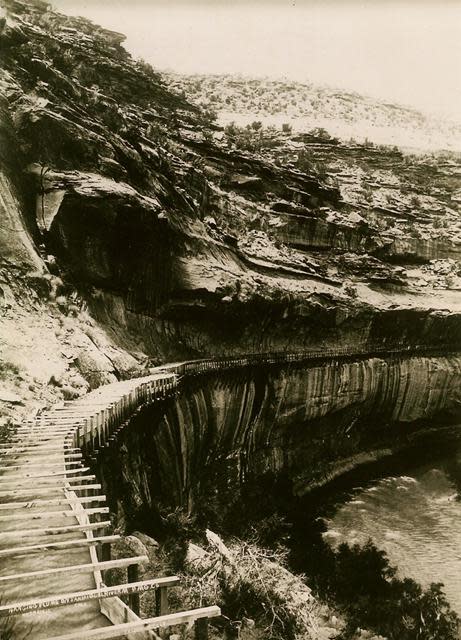
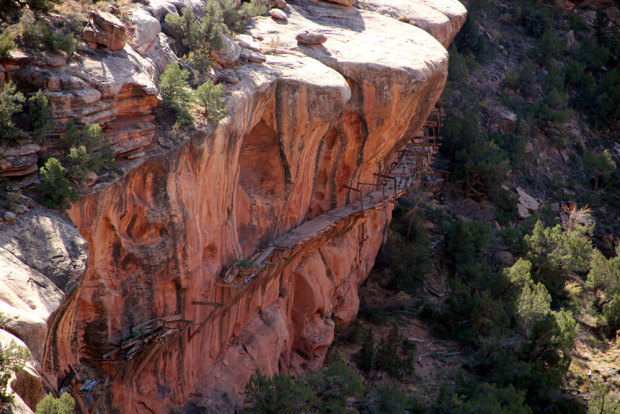
The Hanging Flume is the most intact structure of its kind in the United States, and it is the only hanging flume in a condition suitable for preservation, education and interpretation. It illustrates the ingenuity and fortitude of the engineers and miners intent on extracting gold from the land. The Hanging Flume is a historically significant cultural resource recognized by:

  •  The World Monuments Fund – 2006 Most Endangered Sites list
  •   The State of Colorado – Most Endangered Places of 1999
  •   National Register of Historic Places

Time is Running Out to Document the Flume

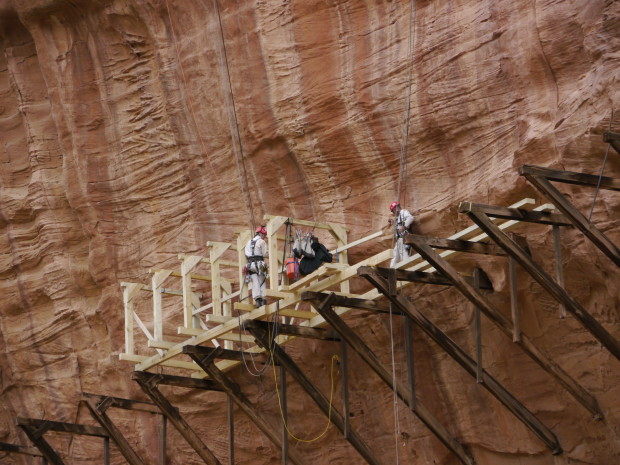
The Hanging Flume is deteriorating as a result of the ongoing effects of exposure to the elements, falling debris and rock slides, and scavenging. The threat of losing key segments of the flume means the time is now to investigate and document remaining sections before the evidence is gone forever. Previous expeditions have documented approximately 10 percent of the remaining sections of the Hanging Flume. At each location, different construction configurations were discovered. The urgency for conducting this project now is that undocumented segments may contain key information on the construction of the Flume that will be lost as the 130-year-old structure continues to deteriorate.

What We Need & What You Get

Your contribution will help the Interpretive Association of Western Colorado send a team of experts to document additional remaining sections of the flume. The original project team that has made expeditions to the flume and produced technical reports over the past decade is ready to conduct the next phase of investigative work. To get the team to the flume, we only need to raise $20,000 more in order to match over $140,000 already raised!

Contributions at any level are greatly appreciated. Contributors at the $50 level will receive a copy of the 60-minute DVD film about the Hanging Flume, “The Best Kept Secret of the Wild West.” Please share our campaign with your network to make an even greater impact!

Learn more and get involved here.