
< Back to Home Page
Technology Highlights

Tablet PC Annotation System (TPASTM)

The efficient collection of accurate data at the earliest stages of a preservation project is critical to the successful implementation of the project. Because decisions about final treatments or use are made based on the evaluation of existing conditions and quantities, the documentation of these conditions must be reliable and in a format that is usable by the entire project team, including design professionals, building owners and contractors. Over several years, Vertical Access has developed increasingly sophisticated methods of collecting digital survey data directly in the field during building investigations. The well developed method of pen-based tablet computers capable of running AutoCAD provides great potential for direct digital annotation.

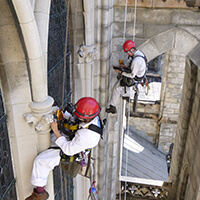
using TPAS in the field

Using TPAS, all data (including digital photography) is entered directly onto the tablet computer, in the field.

The system of documentation currently employed by Vertical Access in the investigation of building conditions is the Tablet PC Annotation System (TPAS). Vertical Access developed TPAS to input both graphical and numerical data directly into AutoCAD, on site, using tablet computers, digital cameras and camcorders. With this system, existing conditions data are noted graphically in AutoCAD using pre-defined block libraries of material conditions. Graphical representation of the data facilitates interpretation and diagnosis of fault patterns and failure mechanisms. In addition, numerical data pertaining to the faults identified, such as crack length and width are also recorded, in attribute tag format.

tablet PC annotation system

The TPAS equipment includes a tablet computer and a digital camera.

TPAS combines the utility of the AutoCAD program commonly used by architects, engineers and other design professionals with customized AutoLISP programming to streamline quantity measurements and photographic documentation. Among the features employed using TPAS that are native to AutoCAD are block libraries, blocks with attribute tags, AutoCAD design center, selective display of layers within viewports and attribute extraction to spreadsheet or database programs. To improve TPAS functionality, Vertical Access has integrated several customized tools into AutoCAD using AutoLISP programming. Custom programming developed by Vertical Access provides enhanced automation to the process of recording conditions by calculating the lengths and areas of conditions drawn and inserted into the AutoCAD drawing and by linking digital photographs, video and AutoCAD data blocks to automate the process of photo capture and cataloging.

direct digital input annotation

Using TPAS, all data (including digital photography) is entered directly onto the tablet computer, in the field.

attribute information including hyperlinks

Attribute information containing such data as: type of material, class of fault/deterioration; severity, extent, or dimension of condition; quantity of the affected area; a hyperlink to a digital photograph, audio or video clip.

Vertical Access has completed several large-scale survey projects using TPAS, including the Brooklyn Post Office and Courthouse in Brooklyn, NY and the Tower of Independence Hall in Philadelphia. Over the course of these projects and many others, Vertical Access has refined the TPAS codes and continues to evaluate its equipment, in a constantly evolving process that will continue in an effort to provide the best project deliverables possible.

More information on TPAS in published articles including:
  • James V. Banta, Kent Diebolt and Michael Gilbert, "The Development and Use of a Tablet PC Annotation System for Conditions Surveys," APT Bulletin 37 (2-3, 2006): 39-45.
    Download this TPAS article
  • Kent Diebolt, James V. Banta and Charles Corbin, "Direct Digital Input of Facade Survey Data Using Handheld Computing Devices" Building Facade Maintenance, Repair and Inspection ASTM STP 1444, J. L. Erdly and T. A. Schwartz, Eds. ASTM International, West Conshohocken, PA, 2004.
See how TPAS works - watch the video demos.

Download the TPAS technology highlight.

Download the TPAS article from the APT Bulletin

Papers and presentations about some of the technology highlighted on this page are available on our resources page.

Email tpas@vertical-access.com for more information.