
|
In this issue... |
|
________________________
To be removed from or subscribe to this newsletter,
please email newsletter@vertical-access.com
To view previous VA Quarterlies, please go to our website
|

 Independence Hall |
Independence
Hall in Philadelphia today stands as a recognizable symbol of both the
first steps in the founding of the United States and of early efforts to
preserve the cultural heritage of the nation.
Although the Baroque/Gibbsian and Georgian architectural elements
of Independence Hall and the adjoining Tower reflect mainstream English
design fashions of its time, the historical events associated with the
structure are more closely connected to the revolutionary beginnings of
the United States. As such a powerful symbol of American historical and
political events, Independence Hall and its Tower have been the focus of
numerous preservation efforts, including a long-awaited Historic
Structure Report (HSR) on the Tower, now being prepared for Independence
National Historical Park by a preservation team led by Bargmann
Hendrie + Archetype, Inc.
Working with
the National Park Service, and team members Keast & Hood Co.,
structural engineers and lead authors, 1:1:6 Technologies, architectural
conservators, and Bruce E. Brooks & Associates, MEP engineers,
Vertical Access conducted a hands-on investigation of the Independence
Hall Tower in April 2006. The
documentation and assessment of the Tower performed by VA was undertaken
as part of the new Tower HSR. This HSR will, for the first time in a
single document, chronicle the origins and development of the tower
construction, characterize its surviving historic fabric, assess its
present condition, and provide a master plan for future maintenance and
capital intervention. The Independence Hall Tower was constructed between
1750 and 1753 as an addition to the lower portion of Independence Hall,
which was built in the 1730's as a Provincial State House.
The builders of the Tower, Edmund Woolley and Ebenezer Tomlinson,
had also constructed the older portions of the Provincial State House
nearly 20 years earlier. By
the last quarter of the 18th century, the upper wood portions
of the Tower were in such a severe state of repair that they were
removed in 1781, leaving only the square masonry base of the Tower,
which was covered with a pyramidal roof and topped by a spire, ball and
weathervane. In 1828, William
Strickland designed and supervised the construction of a new steeple and
spire. The purpose of the
new steeple was to accommodate a bell larger than the original (4600 lbs
versus 2000 lbs) and to incorporate highly visible clock faces.
In a conscious effort to restore the Tower of Independence Hall,
the design of the 1828 steeple recalls the original external appearance
of Woolley's steeple, but with a totally different internal structural
system.
 VA technicians inspecting the cupola at Independence Hall |
After several
campaigns to repair the exterior envelope, reinforce the structural
system, and upgrade the mechanical and electrical systems of the Tower
over its 250-year life, the overall exterior appearance of the Tower
today is for the most part the same as it was in 1828.
The Tower consists of a square masonry base, engaged on its north
facade with the main block of Independence Hall, on top of which rises
a wooden steeple. The
steeple consists of a square clock level and cupola base, an octagonal
cupola, which serves as the Tower belfry, a smaller octagonal lantern
and shingled spire section, and finally the wrought iron and sheet metal
weathervane assembly at the top of the Tower.
VA's
investigation of Independence Hall Tower is truly part of a
collaborative process. In
its survey of the Tower, VA not only documented the existing condition
of the exterior materials, but also recorded previous repairs, both
sound and deteriorating, and types of materials in order to provide the
project team with as much information as possible to develop the
construction chronology of the Tower and evaluate treatment options.
Live-feed video documentation covering over one-third of the
Tower enabled the project team to get a "first-hand" look at the
exterior envelope. The
video documentation supplements the field-annotated drawings and still
photographs collected during the survey of the entire masonry base and
wooden steeple portions of the Tower using TPAS.
Finally, VA took paint, mortar and sealant samples from various
areas of the Tower for analysis by other members of the project team.
The analysis of these materials, along with research of archival
documents and the evaluation of the field survey information will all be
used to generate the Historic Structure Report that will guide the next
phase of the ongoing preservation of the Independence Hall Tower.
For more information, view the project profile of Independence Hall on our website.
-Evan Kopelson [Photos by Jon Reis]
Spire Access Holes at St. Anthony of Padua Church
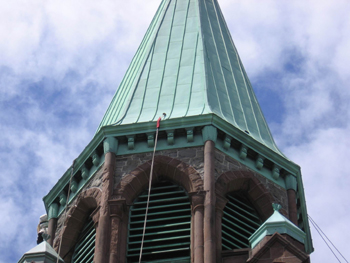 St. Anthony of Padua Church |
When working on historic buildings, the logistics of rigging and access for the survey of a building facade may be just as challenging as the investigation itself. Although designers and builders of traditional buildings often provided some means of access to rooftops and other high areas for maintenance and repairs, this is not always the case. In some buildings, original means of access may have been altered or removed during later interventions.
Vertical Access, working with Historic Building Architects, LLC, Robert Silman Associates and Ivan Myjer of Building and Monument Conservation, recently completed an investigation of St. Anthony of Padua Church in Jersey City, New Jersey. The church, designed by Louis H. Giele in a Victorian Gothic style and constructed in 1892, is on the National Register of Historic Places. To perform its survey of the narthex and tower of the church, VA had to create access openings in the spire of the church because no other means of reaching the upper exterior part of the tower existed. Although historic photographs of the church show dormer windows on at least two facets of the octagonal slate spire, the dormers had been removed and the openings covered when the spire was reclad in copper, long before VA's survey of the exterior.
To gain access to the exterior of the narthex and tower of St. Anthony of Padua, VA cut 1-1/2" diameter access holes in the wood sheathing and sheet copper of the spire roof from the interior to allow for the rigging of ropes at the top of the masonry portion of the tower. A total of six access holes, each located near the bottom of the spire, were used to survey the tower and narthex. Each working line and fall protection line was anchored to structural framing with the church tower and then fed through the access holes until the tails of the ropes reached the ground.
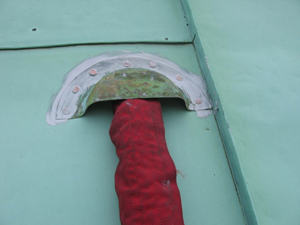 Sheet copper cowl covering access hole |
To cover and waterproof the new access holes in the copper-clad spire, VA designed sheet copper cowls that were manufactured by Vulcan Supply Corporation. The semi-circular cowls are 1-1/2 inches deep to cover the access hole but also allow for the deployment and pulling of ropes through the holes (see photo 1). Prior to the fieldwork, VA pre-patinated the cowls so that they would better blend in with the existing copper spire (see photo 2). At the completion of the survey, VA technicians attached the pre-patinated copper cowls to the exterior of the spire roof. The 1-1/2 wide flange of each cowl was set against the copper roof in a bead of urethane sealant and then nailed to the roof using ring shank copper nails (see photo 3). The ropes used to perform the exterior survey were then pulled through the access holes and a small piece of plywood was screwed to the sheathing at the interior of the spire to keep birds and bats from entering the spire through the hole.
The spire access holes, waterproofed on the exterior using custom-made cowls and covered on the interior with removable plywood, were necessary for VA to perform its survey of St. Anthony of Padua church but will also be useful for future investigative and repair work at the church. Furthermore, because of the relatively small size of the cowls and their location near the bottom of the spire, there is minimal impact on the appearance of the historic church.
For more information, view the project profile of St. Anthony of Padua on our website.
-Evan Kopelson [Photos by Vertical Access]
VA in the News: City Hall, Bay City, Michigan
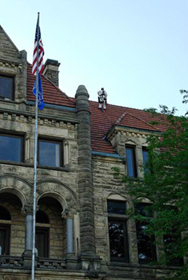 Bay City Hall, Michigan |
Working with Quinn Evans Architects, Vertical Access recently surveyed and investigated the clay tile roof and associated flashings, gutters and masonry of the City Hall in Bay City, Michigan. This work was undertaken to assist QEA with the preparation of documents for the repair of the roof. The City Hall, designed by the local architecture firm of Pratt & Koeppe Architects, and constructed between 1894 and 1897, in the then-popular Richardson Romanesque style, is a prominent building in the city. Situated near the Saginaw River, the historic and present-day focus of the small city, the Bay City City Hall is on the National Register of Historic Places. VA's work on the roof generated quite a bit of publicity in Bay City, with an article appearing in the June 23 edition of Bay City Times, and a write-up of the work by Andrew Rogers on the mybaycity website. City employees working in the building were not only curious about the project and interested to know what VA was doing, but were also extremely helpful and cooperative in allowing VA access to various parts of the building and site.
- Evan Kopelson [Photo by Andy Rogers]
AIC Annual Meeting and Conference
Between June 16 and 19, the American Institute for Conservation of Historic and Artistic Works (AIC) held its 34th Annual Meeting in Providence, Rhode Island. AIC is the professional membership organization for conservators and includes specialty groups that represent areas of expertise and professional interest such as architecture, book and paper, electronic media, objects, paintings, photographic materials, textiles and wooden artifacts. Tobin Tracey, the outgoing program chair and current chair of the architecture specialty group (ASG) organized the ASG conference session, held on June 19. The talks presented at this session covered a wide range of topics, most of which addressed the conference theme of authenticity and the compromises entailed by the use of artifacts. Sam Harris of S. Harris & Co. provided an appropriate context for the day's papers in his discussion of the philosophical notions of authenticity. Several case studies of recently completed preservation projects were presented: Jean Carroon of Goody Clancy & Associates discussed the design and construction process of the restoration of Trinity Church in Boston; Anton Rajer of the University of Wisconsin talked about the technical, political and aesthetic compromises that were made in the restoration of the National Theater of Panama; and Bob Score of Harboe Architects presented the design and fabrication process of the replication of the cornice and colonnade of the Carson Pirie Scott Building in Chicago. Catherine Dewey of the National Park Service juxtaposed the conservation needs of the historic grave makers at Congressional Cemetery in Washington, DC with the use by and preservation benefits to the site by dog walking groups. The remaining papers addressed conservation treatments and materials. John Hinchman of the University of Pennsylvania discussed the testing and evaluation of acrylic emulsion adhesives for the stabilization of the Great Hall Ceiling at Drayton Hall; Sarah Jackson of the National Center for Preservation Testing and Training presented the findings of research on the durability of traditional and modified limewashes; and Ivan Myjer of Building and Monument Conservation examined repairs made to stone prior to the introduction of modern adhesives, focusing on traditional and modern "Dutchman" repairs. Abstracts of these papers are currently posted on the ASG website, http://aic.stanford.edu/sg/asg/index.html, and the final presentations will soon be added to the website.
During the lunch break between presentations, the ASG held its annual business meeting. More than 50 people attended the business meeting, a significant increase from previous years. Representatives of partnership organizations including the Historic Resources Committee of the American Institute of Architects and the Association for Preservation International were present at the meeting and gave reports on the activities of these groups and opportunities for future collaboration. A proposal to offer scholarships to student and early professionals to encourage participation in ASG and the AIC Annual Meeting was passed and will be discussed in the coming weeks on the ASG listserve. Other information discussed at the business meeting, such as an update on the establishment of an examination for certification of conservators and the work of the nominations, communications and public outreach committees of ASG can also be found on the website.

According to today's broad definition of "historic resource," buildings, objects and landscapes are now an important part of a broader cultural environment. Diverse cultural resources are being conserved and "modern" resources and technologies that created them are being acknowledged. APT 2006 will explore the challenges and rewards of this current perspective on the historic, which includes recent events, diverse cultural perspectives, and innovations in architecture, industry and technology.
The conference theme, while addressing issues that apply to the entire preservation community, relates directly to Atlanta, which evolved from a railroad terminus into a commercial and transportation hub. Atlanta and the southeast region embrace our cultural resources as well as our "historic" modern structures.
The conference will be held at the Atlanta Hilton in the heart of downtown Atlanta, Georgia. Come visit us in Atlanta, and enjoy all of the hospitality that the southeast region has to offer.
- From www.apti.org
See the APTI website for more information.
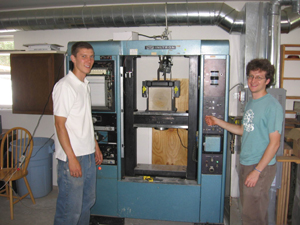 Keith Luscinski and Asa Diebolt at the Instron |
The Vertical Access testing laboratory has been
particularly active this summer. For
the past month, Keith Luscinski and Asa Diebolt have been putting the
lab's Instron Universal Testing Machine to full use to evaluate
materials used routinely in industrial rope access and related work.
Keith is an industrial engineering student at
Cornell University who will be beginning his senior year in the fall.
He is a native of Doylestown, Pennsylvania, spending his first
summer in Ithaca. In
addition to his mechanical and industrial engineering skills, his
experience as a climber has proved useful in the testing work.
Asa is Kent Diebolt's eldest son and Vertical
Access veteran. Asa has
worked on several VA field projects prior to this summer and has helped
in the office putting together reports.
Asa just completed his first year at Macalester College in St.
Paul, Minnesota.