Vertical Access utilizes non-destructive testing and diagnostic techniques to better understand existing conditions and deterioration.
Borescope and Fiber-Optics
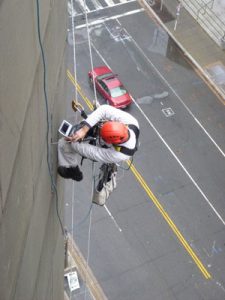 A borescope is an optical device consisting of a rigid or flexible tube with an eyepiece on one end, and a lens on the other end. A remote object is illuminated by a light source and an internal image formed by the objective lens is relayed to the eyepiece, which magnifies the internal image and presents it to the viewer’s eye.
Vertical Access utilizes a variety of borescopes with rigid and flexible tubes as well as ones with a 0° (straight ahead) and 90° direction of view. The borescope allows the user to see behind the facade and requires only a small hole to be drilled. A video camera can be attached to the borescope unit to provide recorded documentation of the conditions behind the facade.
Vertical Access owns and operates another fiber-optic diagnostic tool called the “See Snake” for the investigation of internal leaders, drain pipes, ductwork, cavity walls, crawl spaces, and other locations where human access is not possible. This rugged device consists of a miniature video camera with wide-angle lens and built-in light source attached to 200 feet of heavy duty fiber-optic cable. A built-in odometer records the total distance that the camera travels to assist in locating areas of deterioration.
Infrared Thermography (Thermal Imaging)
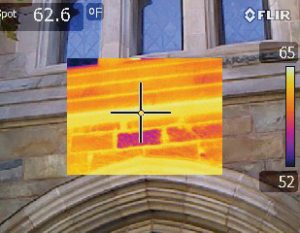 Infrared thermography measures emitted and reflective heat coming from an object. This closely corresponds with the temperature of that object; the hotter it is, the more heat it will emit to its surroundings.
It is useful in building inspections to be able to “see” the heat emanating from a building. Water, for example, will heat up and cool down at a slower rate than the rest of a building façade. This makes it possible to view where there may be water infiltration using a thermal imager because wet areas appear as a different color on the image, whereas a visible light image will not show the temperature differences.
Steel rebar and relieving angles in a facade will similarly change temperature at a different rate than the surrounding material and therefore be distinguishable in a thermal image.
In Situ Material Characterization
Vertical Access can perform in situ material characterization including water absorption (RILEM method) and depth of carbonation of concrete materials (phenolphthalein indicator). This testing performed as part of the investigation helps the project team make informed decisions about potential treatments.
Monitoring Systems Installation
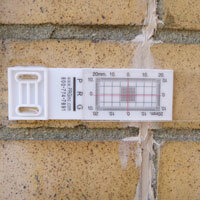
Vertical Access works with your team and product manufacturers to design and install monitoring sensor systems on buildings, monuments, bridges and other large structures. Instruments include ground penetrating radar antennas and crack gauges. Monitoring systems are used to track movement over time due to structural concerns or vibrations from nearby construction.
Using industrial rope access, our team of technicians are able to position workers in remote and challenging areas of your building or structure.
Ultrasonic Thickness Gauge
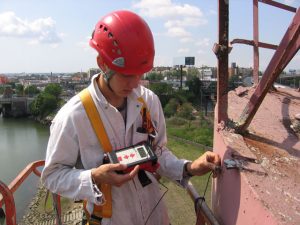 Ultrasonics can be used to determine the thickness of a solid material, such as a metal or plastic. An ultrasonic thickness gauge has a probe that couples to the material and then sends an ultrasonic pulse through the material. When that pulse hits a boundary in the material it gets reflected back. Based on specific material properties and the time delay between when the pulse is sent and then received, it is possible to determine the thickness of that material.
Vertical Access uses a StressTel TM1-CD Ultrasonic Thickness Gauge to determine the existing thickness of solid materials such as copper cladding. To calibrate the instrument and quantify the amount of total section loss, an initial measurement is taken on a non-exposed piece of copper to get a reading on the original thickness, and then a piece of copper with a known thickness is measured to calibrate the thickness gauge.
Wall Tie Locator
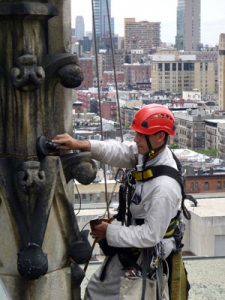 Vertical Access uses a Protovale Imp Wall Tie Locator to quickly find embedded steel, including both mild steel and non-ferrous metals. This is very useful in detecting the presence or absence of wall ties, relieving angles and other pieces of structural metal behind the facade.
Rebar Locator
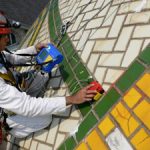 Vertical Access also owns a Proceq Profometer 5, a compact, lightweight instrument specifically used for detecting rebar in concrete. The Profemeter is used to detect reinforcement and mesh, measure their cover depth and determine bar diameter.